Emergency Life Glow Systems
SEVERAL PLACES | CODE REQUIRED | LIFE SAVING| POWER FREE
About Emergency Life Glow Systems
At Emergency Life Glow Systems, we deliver cutting-edge photoluminescent emergency egress systems that light the way to safety—without a single watt of power.
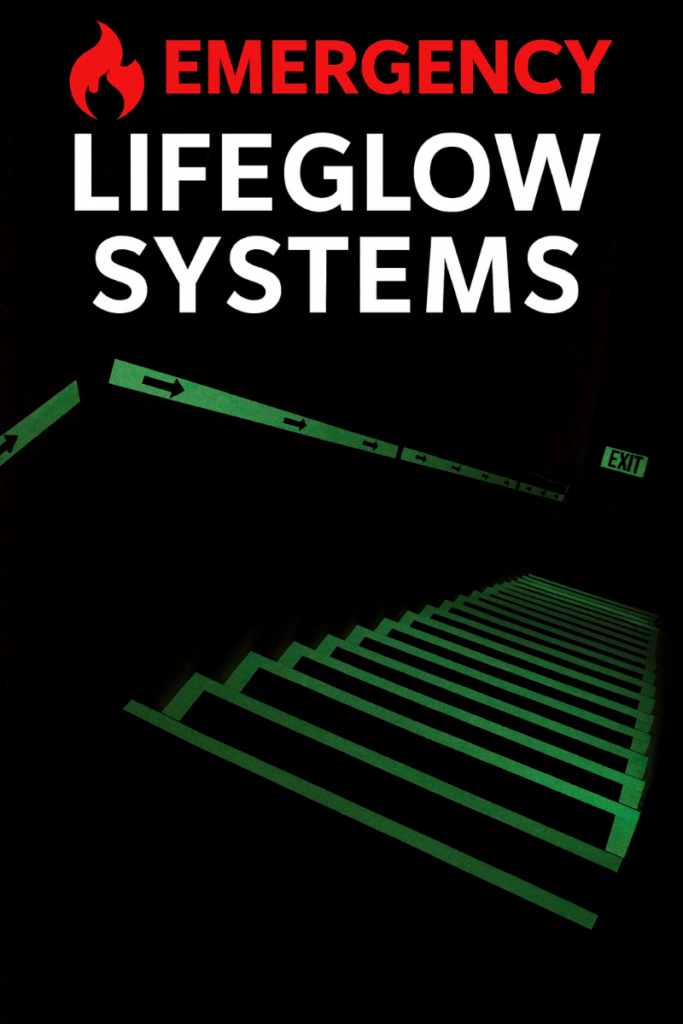
Our passive, glow-in-the-dark technology absorbs everyday ambient light and unleashes a bright, hours-long yellowish-green glow when lights fail. This creates an unmistakable path along stairs, handrails, doors, and floors—guiding occupants safely through blackouts or smoke-filled chaos.
Key Components
- Anti-slip glowing stair nosings
- Handrail and perimeter strips
- Door frame/handle markers
- Obstacle highlights
Completely power-free and fail-safe—no batteries, wiring, or maintenance needed. Unlike electric systems that can fail in crises, ours activate instantly and reliably, saving lives when seconds count.
Mandated by International Building Code (IBC) Section 1025 for high-rises (Groups A, B, E, I-1, M, R-1), non-compliance risks hefty fines and delayed permits.
Best part? Installation is fast and simple—no electrical work. Achieve code compliance immediately and protect your building today.
We’re passionate about sustainable, UL-certified solutions that exceed standards and make evacuations safer for everyone.
Contact us now to glow forward with confidence!
Our Solutions

Stair and Handrail Guidance Systems
Photoluminescent safety strips and markers designed for stairs and handrails. These power-free systems provide clear, continuous guidance during emergencies, ensuring safe navigation in complete darkness or heavy smoke.

Exit and Wayfinding Markers
UL-certified photoluminescent exit signs and directional markers that illuminate emergency egress routes. Our solutions meet international building codes and require no electricity or maintenance for reliable long-term performance.

Emergency Egress Installation Services
Professional installation and consultation services for complete photoluminescent emergency egress systems. Our experts ensure optimal placement and compliance with all safety regulations for maximum protection during evacuations.
FAQ
Photoluminescent (PL) technology refers to materials that absorb light energy (photons) from ambient sources—like sunlight, fluorescent lights, or LEDs—and then re-emit it as visible glow when the lights go out. It’s commonly known as “glow-in-the-dark” technology and is a form of photoluminescence: light emission triggered by the absorption of photons.
Unlike electric emergency lights (which can fail during power outages) or radioactive tritium signs (which require special handling), modern PL materials are non-electric, non-toxic, non radioactive, and require zero maintenance beyond normal cleaning. They provide reliable visibility in blackouts or smoke-filled environments.
Charging (Excitation)
During normal lighting conditions, the material absorbs photons. Electrons in the pigment (often strontium aluminate or similar rare-earth compounds) get excited to higher energy levels.
Energy Storage
The excited electrons become “trapped” in intermediate energy states.
Glow (Emission)
In darkness, the electrons slowly return to their ground state, releasing the stored energy as visible light—typically a yellowish-green glow that’s highly visible to the human eye in low light. This afterglow can last from minutes to over 10 hours, depending on the material quality, charging time, and intensity of ambient light. High-performance products (like those from Ecoglo) exceed building code requirements, glowing brightly for 90+ minutes after just 60 minutes of charging.
The key difference from everyday “glow toys”:
Fluorescence
Instant glow that stops immediately when light is removed (e.g., under blacklight).
Phosphorescence (the basis for safety-grade PL)
Delayed, long-lasting glow due to “forbidden” quantum transitions that slow the energy release.
IBC Section 1025 (found in recent editions like 2021 of the International Building Code) requires glow-in-the-dark (photoluminescent) markings along exit paths in certain high-rise buildings to help people find their way out safely during emergencies, especially when power fails or smoke blocks overhead lights.
In high-rise buildings (any occupied floor more than 75 feet above the lowest level fire trucks can reach).
For specific building types (“occupancy groups”):
A (assembly, like theaters or restaurants)
B (business, like offices)
E (educational, like schools)
I-1 (institutional, like assisted living)
M (mercantile, like stores)
R-1 (hotels/motels)
Applies to interior exit stairways, ramps, and passageways.
Exceptions: Not needed on the main exit discharge level in some lobbies, or in certain open parking garages.
Steps: Continuous stripes on leading edges (nosings) of stairs and landings.
Handrails: Continuous stripes along the top and sides.
Perimeter demarcation: Lines on floors/walls to outline the usable width of landings and walkways.
Obstacles: Anything projecting more than 4 inches into the path and below 6’6″ height (like columns or pipes) gets striped in alternating glow/black patterns.
Doors: Frames and handles marked with glowing stripes; plus a low-level glowing exit symbol visible from the floor.
Directional signs: Where needed for turns or unclear directions.
These markings must be consistent, uniform, and meet brightness standards (tested to UL 1994). They can be photoluminescent (glow after charging from normal lights) or self-luminous—no electricity required.
The goal: Create a visible “trail” at low level that guides people to exits even in total darkness or smoke—proven to save lives in real emergencies.
For the exact official text (2021 edition), visit the ICC website here.